
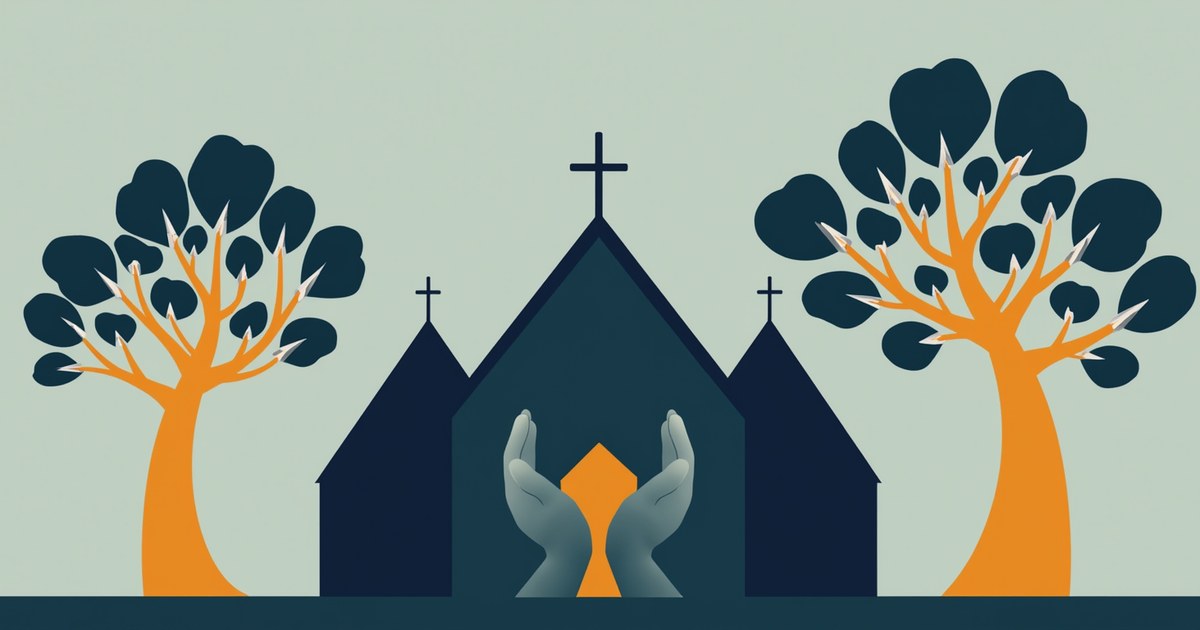

PCEA Karen West Parish, in Milimani South Presbytery, is made up of one congregation: PCEA Muteero Church, begun in 1981 out of the larger Lang’ata Parish. Ten founding families donated the two-acre plot of virgin forest land, designed the sanctuary as two praying hands with ten fingers — the “Thanksgiving Hands” — and named the church after the muteero tree that grew on the land. The wider Karen Parish was inaugurated on 25th January 1998 by the Very Rev. Dr. Jesse Kamau, and in November 2022 it was subdivided, with Muteero Church becoming its own parish: Karen West.
Most churches are named after places, saints, or scripture. PCEA Muteero Church — the heart of today’s Karen West Parish — is named after a tree. And the more its founders studied that tree, the more convinced they became that God had planted a sermon on their land before they had built anything at all.
Ten Families and a Forest Plot
PCEA Muteero started in 1981, born out of the larger Lang’ata Parish at a time when much of the Karen area was still virgin forest with only a scattering of residents. The congregation initially met at Maasai Girls School.
The church stands on a two-acre piece of land donated by ten families, whose names the parish still honours: the late John Wambugu Kariuki, the late Elijah Muriithi Wohoro, Rev. Christopher Gichuhi Kagema, Linus Wahome Gichuki, the late Rev. Prof. Samuel Kibicho, the late Joseph Munuhe, the late Very Rev. Dr. John Gatu, the Very Rev. Dr. George Wanjau, the late Peterson Kariithi Munuhe, and Zachariah Ndegwa Bachia Kanaiya. That list includes two former Moderators of the PCEA General Assembly — a remarkable concentration of church leadership among a single congregation’s founders.
The “Thanksgiving Hands” Design
When it came time to build, the normal practice was to tour churches one admired and copy a design. The Muteero founders chose a different path. As their own record puts it, they put their heads together and arrived at an image: two praying hands with ten fingers — some small, some big, all held together. Ten fingers, ten founding families. They called the design “Thanksgiving Hands,” and it still stands today as a symbol of gratitude to God for the land and the church built on it.
Why “Muteero”? A Sermon in a Tree
The name came from the land itself. Looking at the indigenous trees on the forested plot, the founders’ attention settled on the muteero tree — and the parallels they drew between that tree and the word of God became part of the church’s founding story:
- Its wood has a pleasant scent — as Christians are called to be “the pleasing aroma of Christ” so that others are drawn to the Gospel (2 Corinthians 2:14–15).
- It burns long and bright, making an excellent torch — as the fire of the Gospel should keep burning and give light to many.
- Its charcoal is used by Kenyan communities to treat milk gourds, giving the milk a pleasing flavour — as Christians should be a good flavour to the world.
- Its wood resists termites — as the Gospel endures forever.
The church was named PCEA Muteero Church, and the first structure — corrugated iron sheets, as with so many young congregations — went up while a permanent building was planned. A design by architect Ngure Kairu was later approved, and the new church was opened on 15th November 1998.
The Women Who Held It Together
For its first five years, before elders could formally transfer their church membership, Muteero’s leadership was entirely in the hands of four women: the late Mrs. Gladys Kariuki (Chairlady), the late Mrs. Anne Wambui Maina (Treasurer), the late Mrs. Elizabeth Wambui Riunga (Secretary), and Mrs. Grace Nyawira Kimondo (Sunday School Superintendent). The late Very Rev. Dr. John Gatu recorded this contribution of Muteero’s women in a poem published in his Gikuyu book He Gatu… Nguhe Kanua — and the parish’s written history itself draws on his book Fan into Flame.
The first elders — John Kimondo, the late Joseph Munuhe, and the late John W. Kariuki — were ordained on 13th May 1984, with the late John W. Kariuki as chairman. The first Woman’s Guild members were dedicated a month later, on 10th June 1984.
From Lang’ata to Karen to Karen West
Muteero’s parish journey ran through three stages. It began under the larger Lang’ata Parish in Ngong Hills Presbytery, under Parish Minister Rev. Samuel Maina. On 25th January 1998, the Very Rev. Dr. Jesse Kamau, Moderator of the 15th General Assembly, presided over the subdivision that created Karen Parish — with the leading scripture, “Let the same mind which was in Christ be yours” (Philippians 2:5). The parish began with two congregations, Muteero (1981) and Kuwinda (1985); on 17th December 2006, PCEA Karen Church was born, making three.
Then, in November 2022, the parish was subdivided again into two: Karen West and Karen Central. PCEA Muteero Church became the sole congregation — and host of the parish offices — of the new Karen West Parish in Milimani South Presbytery. Its vision: to be a parish where all people are reached and enlightened on Jesus Christ as Lord and Saviour (Colossians 1:28); its mission: to worship God and serve humanity in obedience to the Great Commission (Matthew 28:19).
Frequently Asked Questions
Why is PCEA Muteero Church named after a tree?
The founders chose the name from the indigenous muteero trees on the donated forest land, drawing parallels between the tree’s qualities — sweet-scented, long-burning, flavour-giving, termite-resistant — and the enduring word of God.
When did Karen West become its own parish?
In November 2022, when the larger Karen Parish was subdivided into Karen West and Karen Central. PCEA Muteero Church became the congregation and office host of Karen West Parish.
What is the “Thanksgiving Hands” design?
The sanctuary’s design, conceived by the founders themselves: two praying hands with ten fingers held together, representing the ten families who donated the land — a permanent symbol of gratitude to God.
Final Thoughts
Karen West is, in one sense, the Presbytery’s youngest parish — formally created only in November 2022. In another sense it is one of its most storied: four decades of history, founders who included two General Assembly Moderators, a sanctuary shaped like praying hands, and a name that turns an indigenous tree into a standing sermon. New parish, deep roots — quite literally.
Want to Visit or Connect with Karen West Parish?
Reach out to the Presbytery office to learn more about Karen West Parish and Muteero Church.
Historical details in this article are drawn from PCEA Milimani South Presbytery’s own published parish records, which in turn draw on the late Very Rev. Dr. John Gatu’s book “Fan into Flame.” Compiled by the Editorial Desk.