
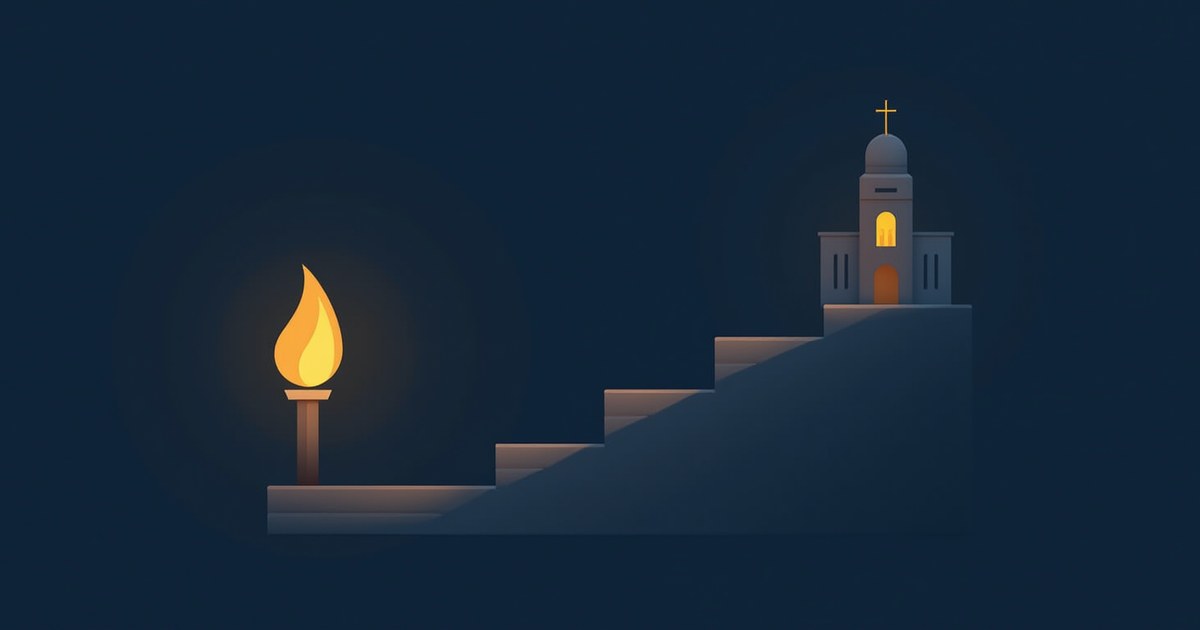

PCEA Nairobi West Parish began in late 1982 as PCEA Church of the Torch, Nairobi South C, worshipping in a Ministry of Works staff-quarters chapel on the site of today’s Moi Educational Centre. Registered on 29th May 1983, the congregation relocated to its present site in May 1984 — taking the name PCEA Nairobi West Church — and grew from about 50 members to a congregation of hundreds. It joined the new Milimani Presbytery in January 1996 and was inaugurated as PCEA Nairobi West Parish in January 1998. Today the parish comprises PCEA Nairobi West Church and PCEA South B Church.
Every parish in PCEA Milimani South Presbytery has a founding story, but few began under a name as striking as this one: the Church of the Torch, Nairobi South C. This is how a retired prisons chaplain, a borrowed classroom, and a handful of determined elders became one of Nairobi’s established Presbyterian parishes.
A Chapel in the Staff Quarters, 1982
The church was started in late 1982 under the name PCEA Church of the Torch, Nairobi South C. Its first home was not a church building at all — it met at the Ministry of Works staff quarters, in a space that served as both chapel and adult literacy classroom, on the site where Moi Educational Centre stands today.
The first Minister to serve the congregation was Rev. Geoffrey M. Ngare, who took up the work in late 1982 after retiring from the Prisons Service Chaplaincy. By the end of that year he had approached two elders — George Wanyingi Karuri of PCEA Lang’ata Church and the late Gerald Njoroge of Thogota Parish’s Githima Church, both then working at the Prisons Department opposite Wilson Airport — to join him. The late Elder Tabitha Githaiga, then a Deacon at PCEA Lang’ata Church, completed the founding team.
Together they mobilized PCEA members living around Nairobi South B, South C, Mariakani, Madaraka, Golf Course, and Nairobi West to form a congregation, overseen at first by the Session of St Andrew’s Church. The church was formally registered on 29th May 1983. Other pioneer elders who lent a hand from their own parishes included Samuel Kabiru and D.M. Ngurimu of Mathare Parish, and Shadrack Mwangi of Lang’ata Parish.
Four Services, Four Congregations in One
What is remarkable about the young church is how quickly it organized itself. The first congregation, formed in November 1982, consisted largely of church school children and four families. From there, services multiplied:
- Church School (8:15–9:15 am) — the very first service, begun in late 1982.
- Kikuyu Service (10:30–12:00 noon) — launched in March 1983 by Rev. Ngare with seven founding members.
- English Service (9:20–10:15 am) — introduced in August 1983 alongside the formation of the Youth group.
- Kiswahili Service — launched in August 1983 together with the Woman’s Guild; discontinued for a period, then revived in a mid-morning slot.
The first Local Church Committee was formed on 15th May 1983, chaired by Rev. Geoffrey M. Ngare, with Samuel Kabiru as Vice-Chairman, George W. Karuri as Secretary, and the late Elder Tabitha Githaiga as Treasurer. The first deacons were inducted just a month later, on 19th June 1983. Committees followed in quick succession — Building (March 1984), Finance and Development (August 1984), Worship (August 1984) — along with the Woman’s Guild and Youth Fellowship (August 1983), the Church Choir (early 1984), the Boys’ & Girls’ Brigade (February 1989), and a nursery school project (March 1990).
The Move to Nairobi West, 1984
When the government condemned the Ministry of Works staff quarters, the congregation had to move. In May 1984 it relocated to its present site — and with the move came a new name: PCEA Nairobi West Church.
Construction of a temporary mabati sanctuary began on 7th April 1984 and was completed by September that year; it was dedicated on 21st September 1986 by Rev. Moses Waweru, then Moderator of Ngong Hills Presbytery. In March 1989 work began on the minister’s housing — ultimately two maisonettes, one designated as the manse and the other for rental income — completed and dedicated in June 1992 by Rev. Stephen Kariuki.
The permanent sanctuary took longer, as it usually does. An ad-hoc Harambee sub-committee was formed in 1985 to raise funds. The groundbreaking was officiated on 5th June 1988 by the Rt. Rev. Dr. George Wanjau, Moderator of the 12th General Assembly; the foundation stone was laid a decade later, on 9th August 1998, by the Rt. Rev. Dr. Jesse M. Kamau, Moderator of the 15th General Assembly. On 25th February 2001, the church sanctuary was dedicated by Rev. Samuel Murigu Njoroge, Moderator of Milimani Presbytery.
From Congregation to Parish
The chronology of Nairobi West’s growth reads like a case study in steady, patient church planting. By the end of 1983, the church had grown to about 50 members. In February 1985 the church plot was dedicated by Rev. Dr. George Wanjau. In September 1986, when the Lang’ata Deacon Courts were inaugurated into a parish, PCEA Nairobi West Church joined as one of its congregations — by then already 300 members strong, with 60 children in church school.
Two milestones then reshaped its place in the wider church. In January 1996, Nairobi West became part of the new Milimani Presbytery, carved out of the Greater Ngong Hills Presbytery by the Rt. Rev. Bernard Muindi, Moderator of the 14th General Assembly. And in January 1998, PCEA Nairobi West Parish was inaugurated by the Rt. Rev. Jesse Kamau — the same wave of 1998 parish inaugurations that also established Lang’ata and Karen as parishes in their own right.
Today, PCEA Nairobi West Parish comprises two congregations: PCEA Nairobi West Church and PCEA South B Church — a fitting outcome for a church whose founding team once canvassed South B and South C estates looking for scattered Presbyterians.
Frequently Asked Questions
Why was PCEA Nairobi West originally called “Church of the Torch”?
The congregation began in late 1982 under the name PCEA Church of the Torch, Nairobi South C, while worshipping at the Ministry of Works staff quarters. It took the name PCEA Nairobi West Church after relocating to its present site in May 1984.
When did PCEA Nairobi West become a full parish?
In January 1998, when PCEA Nairobi West Parish was inaugurated by the Rt. Rev. Jesse Kamau, Moderator of the 15th General Assembly — two years after joining the newly created Milimani Presbytery in January 1996.
Which congregations make up PCEA Nairobi West Parish?
Two: PCEA Nairobi West Church and PCEA South B Church.
Final Thoughts
From a condemned staff-quarters chapel to a dedicated sanctuary; from four founding families to a parish of two congregations — the story of PCEA Nairobi West is one of ordinary believers doing patient work over decades. The torch in its first name turned out to be apt: lit in a borrowed classroom in 1982, it has yet to go out.
Want to Visit or Connect with Nairobi West Parish?
Reach out to the Presbytery office to learn more about Nairobi West Parish and its congregations.
Historical details in this article are drawn from PCEA Milimani South Presbytery’s own published parish records. Compiled by the Editorial Desk.